



Blog
A hidden loss in an SMT workshop is any recurring cost that does not appear clearly as scrap, labor, or a single machine failure, but quietly reduces output, quality, and delivery reliability. It may be a feeder that causes occasional pickup errors, a worn nozzle that increases placement variation, reels waiting at the wrong point in the line, or inspection data that identifies defects without preventing their return.
These losses are difficult because each event can look minor. A short stoppage may be cleared in minutes. One board may be reworked instead of scrapped. An operator may compensate for a recurring material issue without recording it. Over time, however, the workshop loses usable machine time, consumes more components, creates unstable cycle times, and makes production planning less trustworthy.
The practical question is not simply, “Where are defects occurring?” It is: where is the PCB assembly line consuming time, materials, or attention without producing good boards at the expected rate?
Downtime is more than a stopped machine
Unplanned downtime is one of the most visible hidden losses, but it is often measured too narrowly. A placement machine that stops for an alarm is obvious. The larger loss may include the time needed to diagnose the issue, find a replacement part, reset the process, verify the first boards after restart, and recover the sequence of work orders that were delayed.
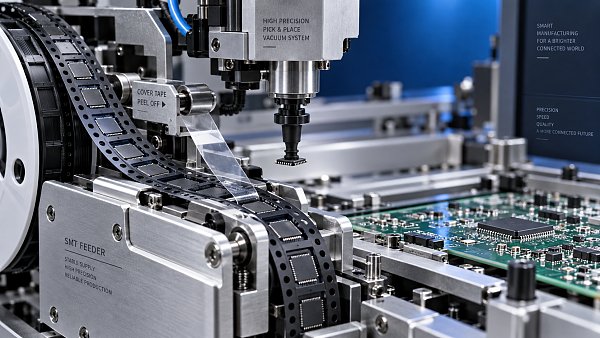
Short interruptions deserve attention because they are easily normalized. A line may stop repeatedly for feeder loading, tape jams, nozzle cleaning, fiducial recognition errors, or board transfer problems. None of these events may be long enough to trigger a major escalation, yet their combined effect reduces the line's effective capacity.
Machine availability should therefore be reviewed together with the reason for each interruption. “Operator intervention” is not a useful final category. It needs to be broken down into causes such as material setup, feeder condition, nozzle wear, conveyor alignment, program data, sensor faults, or preventive maintenance gaps. Only then can a team decide whether the problem is process discipline, consumable condition, spare-parts readiness, or equipment reliability.
The spare part is often not the only issue
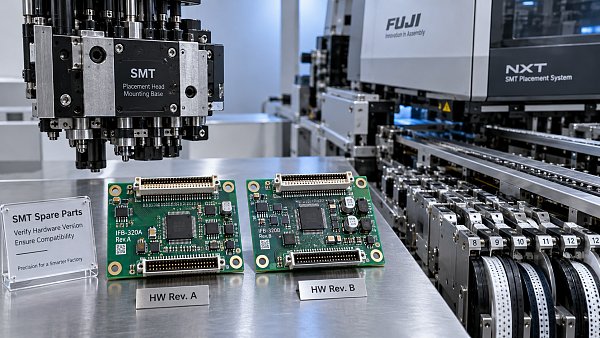
A common response to recurring stoppages is to keep more spare parts. That can be sensible for components with a predictable service life or long replacement lead time, but it does not solve every problem. A workshop also needs the correct part identification, a clear storage location, a process for confirming compatibility, and a record of why the previous part failed.
Using non-original or poorly matched machine parts can create another layer of hidden loss. The part may fit physically while affecting feeding accuracy, pickup stability, vacuum performance, or mechanical movement. The resulting defects may be intermittent, which makes them expensive to diagnose. For critical placement-machine components, original machine spare parts are often valuable not because they eliminate all failures, but because they reduce an avoidable source of process variation.
Material handling can quietly consume a line's capacity
In SMT production, components do not create value while they are being searched for, verified, moved, counted, or corrected. Material handling becomes a hidden loss when the line is technically ready but cannot run at its intended pace because the next reel, tray, stencil, adhesive, or PCB lot is not ready at the point of use.
This is especially common when production changes frequently. A high-mix line may appear busy all day while spending a substantial portion of its time in setup, verification, feeder preparation, and partial changeovers. The answer is not always to buy faster equipment. In many cases, the larger improvement comes from making preparation work happen before the machine becomes idle.
That means separating offline preparation from line-stopping activity where the process allows it. Feeders can be loaded and verified in advance. Component reels can be checked against the work order before they reach the machine. Program revisions, feeder maps, stencil availability, and PCB orientation can be confirmed before the current job is completed. The objective is not to rush setup; it is to remove avoidable uncertainty from the moment when equipment should be producing.
Rework hides the true cost of a defect
Scrap is easy to see. Rework is easier to tolerate because the board may still ship. That makes rework one of the most underestimated hidden losses in an SMT workshop.
A reworked board uses inspection time, technician time, repair materials, retesting capacity, and production-floor attention. It may also disrupt traceability or create handling risk for sensitive assemblies. Some defects can be corrected reliably; others introduce uncertainty that is not visible in a simple pass/fail count. A line with low scrap but frequent rework is not necessarily a healthy line.
The most useful distinction is between a one-off defect and a repeating defect pattern. If tombstoning, solder bridging, insufficient solder, polarity errors, missing components, or placement offsets recur, treating individual boards is not enough. The process needs a feedback loop that identifies whether the source is printing, placement, reflow, materials, program data, board design, or handling.
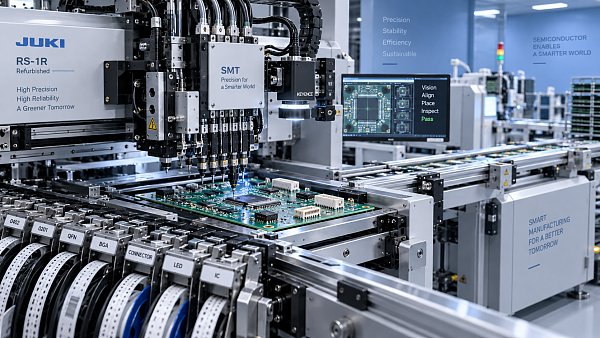
Inspection equipment is valuable when it helps make that loop shorter. SPI, AOI, X-ray, and functional test do different jobs. They should not be viewed as interchangeable “quality gates.” For example, a defect found after reflow may originate in solder paste deposition, while a placement issue may relate to nozzle condition, component recognition, feeder behavior, or PCB support. The closer the detection point is to the origin of the defect, the less material and time are spent creating boards that will require repair.
When speed creates instability instead of output
It is tempting to judge an SMT line by its rated speed or by the fastest observed cycle time. Real output depends on sustained, repeatable production of acceptable boards. A program optimized only for nominal speed can create more feeder interventions, missed placements, component damage, or inspection failures. The line may look fast during a short run and perform poorly across the full shift.
This does not mean that cycle-time optimization is unimportant. It means the changes should be evaluated against stable operation. A placement sequence, feeder allocation, conveyor setting, or reflow profile should improve the total result: good boards completed, predictable changeovers, manageable maintenance, and fewer recoveries. If an adjustment saves seconds but adds repeated manual intervention, it has probably moved the loss rather than removed it.
Board mix changes this judgment. For stable, high-volume products, dedicated setup and tightly optimized programs may be justified. For frequent product changes, repeatable setup rules, clear feeder control, and rapid verification may deliver more value than pursuing the smallest possible placement cycle time. The best operating method depends on the line's product mix, component variety, and quality risk, not on a single machine specification.
Maintenance loses value when it is only reactive
Reactive maintenance restores production after something fails. Preventive maintenance protects production before the failure reaches the schedule. The hidden loss appears when maintenance is consistently postponed because the line is busy, then carried out under pressure during an urgent stoppage.
Not every part requires the same maintenance approach. Nozzles, feeders, filters, belts, sensors, vacuum-related components, and mechanical wear items affect the process in different ways. Some fail abruptly; others gradually create variation. A practical maintenance plan links each item to its likely failure mode and to the consequences of failure. Parts that can stop the line or create hard-to-detect quality issues require more deliberate control than low-risk items that are easy to replace.
Maintenance records should support decisions, not merely prove that a task was completed. When a component is replaced, the useful record includes the symptom, the affected machine or station, the production impact, and whether the replacement corrected the issue. Repeated replacement of the same type of item may indicate a wider problem, such as improper cleaning, material contamination, setup damage, or an unsuitable replacement part.
Production data becomes a loss when no one acts on it
Most SMT lines generate alarms, downtime records, yield reports, inspection images, repair notes, and material transactions. The hidden loss is not a lack of data. It is data that remains disconnected from daily decisions.
A useful review does not need to begin with a complex dashboard. Start with a short period of production and identify the repeated reasons the line did not produce good boards as planned. Compare machine stops with feeder or nozzle events. Compare repair categories with inspection findings. Check whether the same issue appears across particular products, component packages, shifts, or machines.
Look for recurring patterns rather than isolated incidents. A defect that appears occasionally across several products may point to equipment condition or process control. A defect restricted to one product may point to PCB design, stencil design, component packaging, program data, or a product-specific profile. This distinction prevents teams from replacing equipment parts when the actual source is in preparation or engineering data.
A practical way to uncover hidden loss
Trying to fix every inefficiency at once usually produces a long action list with little improvement. A better approach is to follow the path of a work order through the workshop and identify where planned flow breaks down.
- Define the expected route. Map preparation, printing, placement, reflow, inspection, repair, and final release. Include handoffs and material movements, not only machines.
- Record interruptions in usable categories. Separate material waiting, setup errors, feeder faults, machine alarms, quality holds, program corrections, and maintenance events.
- Follow one recurring loss to its origin. Do not stop at “machine stopped” or “board failed inspection.” Trace the event back to the condition that made it likely.
- Choose the correction with the lowest disruption. This may be a feeder maintenance rule, better reel labeling, an offline setup station, a spare-parts control method, or a program-verification step.
- Check whether the correction holds. A change is only useful if it reduces repeated intervention without creating a new issue elsewhere in the line.
This process also helps distinguish a local equipment problem from a line-design problem. A single aging feeder may need replacement. Repeated material delays across several machines may call for a different preparation flow. Frequent transfer issues can require attention to the interface between stations, PCB handling settings, or overall line layout.
Where equipment and line solutions fit
Equipment investment has the strongest effect when it targets a known loss mechanism. Replacing a machine simply because it is older may not resolve poor material preparation, inconsistent stencil cleaning, weak inspection feedback, or missing spare-parts control. Conversely, continuing to compensate manually for recurring equipment limitations can turn labor and quality risk into a permanent operating cost.
When reviewing SMT/THT assembly equipment, spare parts, or a complete PCB assembly line solution, assess the entire production flow. Confirm compatibility between stations, how boards and materials move through the line, whether setup work can be prepared efficiently, and how inspection results return to the process. For replacement parts, prioritize correct fit, traceability, and the role the part plays in placement accuracy or machine uptime.
SMT MALLS supports this type of evaluation through SMT/THT assembly equipment, original machine spare parts, and complete PCB assembly line solutions. The relevant starting point is not a generic equipment list. It is the specific loss that keeps consuming capacity: unstable feeding, excessive changeover time, repeated stoppages, weak inspection feedback, or a mismatch between connected stations.
Hidden loss rarely disappears through one dramatic improvement. It is reduced when the workshop stops treating small interruptions, rework, and recurring workarounds as normal. Once those events are visible and connected to their causes, decisions about maintenance, spares, equipment, and line configuration become much more practical.


GET A FREE QUOTE
Simply fill in the information to get a free quote! Our professional team customizes photovoltaic solutions for you, provides accurate quotes, and rejects hidden consumption!
