



It often starts the same way on the line: the machine powers up, but something feels off. The interface may freeze, alarms may appear without a clear pattern, feeder-related actions may respond slowly, or the system may restart after a short run. In a semiconductor or SMT assembly environment, that kind of instability is not just annoying. It interrupts production rhythm, forces repeated checks, and creates uncertainty about whether the problem is minor wiring noise or a control issue that could become more serious.
When that happens, many people search for NXTR控制箱维修 because the control box sits at the center of machine coordination. If it is not receiving stable power, processing signals correctly, or communicating cleanly with connected modules, symptoms can spread across the equipment and look like several unrelated faults. The difficulty is that the first visible alarm is not always the actual cause. A reset may temporarily clear the issue, but repeated resets can hide a worsening electrical or board-level problem.
Why control box faults are so disruptive in real production
The control box is where power distribution, signal conversion, protection logic, and communication functions often meet. When it develops a fault, the machine may still appear partly alive. Fans can run, indicator lights can come on, and some axes or peripheral devices may initialize normally. That partial operation makes diagnosis harder, because operators may assume the machine is generally healthy and focus only on the alarm message being displayed.
In practice, a control box problem can affect several layers at once:
- Startup behavior becomes inconsistent.
- Machine communication with modules or sensors drops intermittently.
- I/O response lags or becomes unstable.
- Protective shutdowns occur even though the mechanical section seems normal.
- Temperature rise inside the electrical area leads to repeat failures after reboot.
This is why rushed intervention can make things worse. If a connector is reseated without documenting the original condition, or if boards are swapped before basic power checks are completed, the equipment may become harder to restore. A clean repair process is usually faster than a random one, even when the line is under pressure.
Common failure patterns people usually encounter first
Most control box issues do not present themselves as a clearly labeled internal board defect. They show up as symptoms. A machine may fail to complete boot sequence, lose communication with a sub-unit, throw repeated servo or I/O alarms, or run normally until heat builds up. These are the patterns many people see before they know whether NXTR控制箱维修 is truly required.
Power instability
If incoming power is unstable, or if internal power supply units in the box are weak, the machine may start and stop unpredictably. You may notice reboots, alarm bursts during initialization, or LEDs that change status without an obvious command. A failing supply can also create misleading secondary alarms because downstream boards do not receive clean voltage.
Connector and harness problems
Loose, oxidized, overheated, or mechanically stressed connections are a common source of trouble. The fault may appear after maintenance, machine movement, vibration, or thermal cycling. In many cases the connector is not fully disconnected, so the machine still works sometimes. That intermittent behavior often causes the most confusion.
Cooling-related stress
Dust buildup, reduced fan performance, blocked airflow, or poor cabinet sealing can gradually increase internal temperature. The result is not always an immediate shutdown. Sometimes the machine runs until a certain load level is reached, then communication errors or board instability begin to appear. If the fault happens only after some operating time, heat should always be considered.
I/O board or communication board degradation
Signal handling boards can fail in ways that resemble sensor problems, actuator problems, or software faults. Inputs may not register consistently. Outputs may trigger with delay. Communication may drop only on specific channels. Without step-by-step isolation, it is easy to replace the wrong part.
Grounding and noise interference
Electrical noise is often overlooked because it does not leave an obvious physical mark. Poor grounding, shield termination issues, or nearby interference sources can corrupt signals and create unstable machine behavior. This becomes especially important in high-density equipment where multiple control functions share limited cabinet space.
Where repair attempts become risky
A control box is not just another enclosure to open and probe casually. Even experienced maintenance personnel know that the main risk is not only electric shock. The larger problem is causing secondary damage while trying to locate the original fault.
One common mistake is measuring live points without a clear reference plan. Another is replacing boards between machines simply to “test quickly,” which can transfer an unknown fault to a healthy unit or create configuration mismatch. Static discharge is also a real concern when handling control boards, especially if the work area and tools are not prepared properly.
There is also a documentation risk. If connectors, jumpers, or board positions are changed without recording the original state, later troubleshooting becomes less reliable. In urgent repair situations, people often remember the alarm but forget the sequence: whether the fan had stopped first, whether the power rail dropped under load, or whether the communication fault only appeared after a cabinet was closed. Those details matter.
A more reliable way to narrow down the fault
When the machine is down, the pressure to act fast is real. Still, a short structured check usually saves time. The goal is to separate input problems, internal box problems, and external load problems before touching the more sensitive components.
Start from machine behavior, not assumptions
Before opening anything, note the exact symptom pattern. Does the machine fail at power-on, during initialization, or only after running? Is the alarm fixed or changing? Do all connected modules fail together, or only one area? A symptom that affects many functions at once often points to power, communication backbone, or common I/O rather than a single actuator.
Verify the basic electrical condition
Check incoming power quality, protective devices, grounding continuity, and visible signs such as discoloration, heat marks, or unusual odor. If the machine has been restarting, do not jump immediately to board replacement. Confirm whether the supply rails remain stable during startup and under operating load. A supply that looks normal at idle may collapse when the system demands current.
Inspect the physical condition inside the box
Look for loose terminals, connector seating issues, bent pins, fan obstruction, damaged cable insulation, or signs of moisture and contamination. Pay attention to corners that are easy to miss. Some faults come from vibration or cable strain near cabinet entry points, not from the board itself.
Separate internal fault from external load influence
If possible, isolate sections methodically. A shorted peripheral, damaged sensor line, or failing downstream module can pull down a power rail or disrupt communication, making the control box appear defective. Disconnecting or isolating branches in a controlled way can reveal whether the fault remains internal or is being triggered from outside.
Use status indicators carefully
LEDs, diagnostic codes, and machine logs are useful, but they should be read as clues, not final answers. A communication alarm may be caused by the communication board, the cable, the power condition, or the connected device. Match the indication with measured electrical reality before deciding.
When the issue really points to NXTR control box repair
After external wiring, power input, and connected loads are checked, some signs more strongly suggest true NXTR控制箱维修 rather than a field wiring problem. These include repeated internal rail instability, visible board damage, persistent communication failure on known-good cables and modules, recurring thermal shutdown despite restored cooling, or I/O behavior that stays abnormal after signal path verification.
At that point, the priority is not to keep cycling power in hope of recovery. Repeated energizing can increase damage if a component is already stressed. It is better to stop, preserve the fault condition as much as possible, and decide whether board-level inspection or replacement of specific internal assemblies is the safer route.
Service priorities that usually make the most sense
Not every fault deserves the same response. In a real production setting, service priority is usually determined by risk, repeatability, and the chance of expanding damage.
If there is burning smell, visible heat damage, arcing marks, or cabinet overheating, safety and isolation come first. Do not continue trial starts. If the machine loses control intermittently, communication drops during operation, or outputs behave unpredictably, the issue should be treated as high priority because unstable control can create wider machine problems.
By contrast, a single startup alarm that can be clearly traced to a loose external connector may be lower risk once verified. The point is to distinguish between a local correctable issue and a control-box-centered instability.
In many maintenance environments, the practical service order looks like this: secure the machine, preserve fault information, verify incoming conditions, inspect physical connections and cooling, isolate external loads, then move toward internal board diagnosis or controlled replacement. That order is less dramatic than swapping parts quickly, but it usually reduces misjudgment.
What operators can do before escalating
Not every user is expected to perform internal electronic repair, and in many sites they should not. Still, there are useful actions that help the next step go faster and safer.
- Record the exact alarm text or code sequence.
- Note whether the fault appears immediately or after warm-up.
- Observe fan operation and cabinet temperature trend.
- Check for recent maintenance, cable movement, or unusual vibration.
- Report whether the fault affects one section or the whole machine.
These details often matter more than a general statement like “machine cannot run.” Good observation can shorten the path to the right repair decision without anyone guessing.
Choosing parts and support without turning the repair into another problem
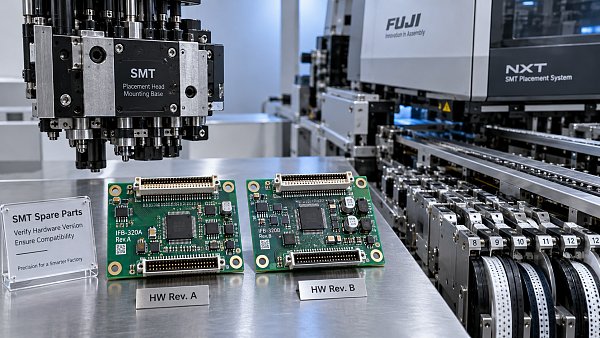
Once repair direction is clear, the next challenge is support quality. For control box work, the wrong spare part, an incompatible board revision, or poor handling during installation can delay recovery more than the original fault. It helps to confirm part identity carefully, check interface compatibility, and avoid mixing uncertain components into a machine that already has unstable behavior.
For operations that deal with SMT and semiconductor assembly equipment, having access to original machine spare parts and PCB line support can be useful as part of a broader maintenance path, especially when the control issue interacts with other machine sections. The key is not to treat every fault as a parts-only problem. A replacement board may be necessary, but it should follow fault isolation rather than replace it.
Reducing the chance of the same failure returning
After repair, many repeat issues come from the conditions around the control box rather than the repaired item alone. If airflow remains poor, if cable strain is unchanged, or if grounding problems are left in place, the machine may return with similar symptoms.
It is worth checking whether the cabinet environment is stable, whether fans are actually moving air effectively, whether connectors are secured against vibration, and whether maintenance records reflect the exact action taken. If a board was replaced, keep note of the fault pattern that led to that decision. Later, if a similar symptom appears, you will know whether it is likely the same root cause or just the same alarm appearing for a different reason.
The most useful mindset is simple: treat the control box as a system node, not a single part. That makes NXTR控制箱维修 less about chasing alarms and more about understanding the electrical path, the machine behavior, and the repair risks before touching the hardware. In a production environment, that approach is usually the difference between a quick temporary recovery and a stable return to operation.


GET A FREE QUOTE
Simply fill in the information to get a free quote! Our professional team customizes photovoltaic solutions for you, provides accurate quotes, and rejects hidden consumption!
