



Blog
When Do SMT Equipment Maintenance Services Reduce Unplanned Downtime?
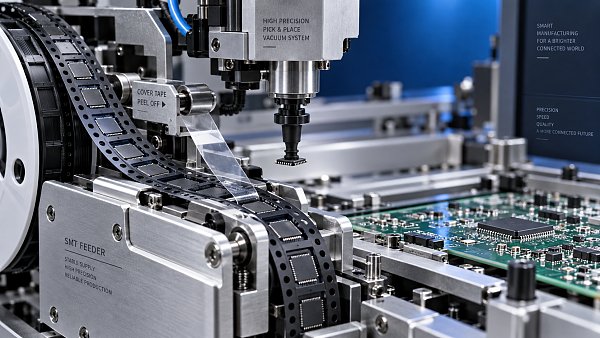
For semiconductor component manufacturers, an SMT line rarely fails at a convenient moment. A placement machine may begin showing minor feeder errors during a high-mix run. Reflow profiles may drift after a period of stable production. An aging conveyor belt, vacuum filter, nozzle, sensor, or board-handling mechanism can create intermittent faults that are difficult to reproduce until the line is already stopped.
The cost is not limited to lost machine hours. Unplanned downtime can interrupt material control, delay downstream inspection and packaging, complicate traceability, increase the chance of work-in-process damage, and force planners to make difficult delivery commitments. In component manufacturing, where process consistency and output planning are closely linked, maintenance is most effective when it prevents a developing condition from becoming a production event.
SMT Equipment Maintenance Services reduce unplanned downtime when they are connected to actual operating conditions: equipment age, product mix, changeover frequency, material characteristics, shift patterns, environmental exposure, and the availability of correct spare parts. A generic service visit may restore a machine temporarily. A maintenance program built around the line’s failure modes is more likely to protect capacity over time.
The point at which maintenance becomes downtime prevention
Maintenance does not reduce stoppages simply because it is scheduled. It works when inspection and intervention occur before wear crosses the point at which machine performance becomes unstable. That point differs by machine and application. A high-speed chip shooter running repetitive production may accumulate mechanical wear in predictable areas. A flexible placer used for frequent product changes may be more exposed to feeder setup issues, nozzle handling problems, operator variation, and accumulated calibration drift.
The strongest early indicators are often not complete failures. They are changes in normal behavior: rising placement rejects, recurring vision alarms, feeder pickup inconsistency, longer homing sequences, unusual pneumatic response, intermittent board-transfer faults, or increasing manual intervention during a shift. These signals should not automatically trigger major replacement work, but they do justify structured diagnosis before the condition affects delivery.
In practice, maintenance services are especially valuable in four situations:
- When the line has recurring minor alarms that operators clear repeatedly but engineering has not yet traced to a root cause.
- When output demand has increased and equipment is being run for longer periods, leaving less room for reactive repair.
- When a machine is approaching a planned production peak, product launch, qualification run, or customer delivery window.
- When original wear parts or machine-specific assemblies have long replenishment times and a failure would create an extended stop.
The common mistake is to judge maintenance only by whether the machine is currently running. A line can be technically operational while gradually losing process margin. For semiconductor-related assemblies, small deterioration in placement accuracy, solder paste transfer, thermal repeatability, or board handling may appear first as quality variation rather than a machine alarm. Waiting for an obvious breakdown often means waiting too long.
Preventive work matters most when it is based on risk, not calendar habit
Time-based maintenance remains useful, particularly for components with known service intervals. Lubrication points, filters, belts, bearings, pneumatic elements, moving assemblies, and certain consumables all require attention before they reach an unreliable state. But a calendar alone cannot explain why two identical machines may need different maintenance priorities.
One may run low-volume, high-complexity products with frequent feeder changes and different board dimensions. Another may operate in a more repetitive environment but at a much higher duty cycle. Humidity, dust, compressed-air quality, operator practices, cleaning discipline, and the type of solder paste or adhesive used can all influence what fails first. A practical maintenance plan combines manufacturer guidance with the production history of the individual asset.
This is where service records become more useful than a simple checklist. A good record should show not only that an inspection took place, but what was found, what was adjusted, which parts were replaced, whether the issue had appeared before, and whether it affected quality or throughput. Over time, this allows maintenance teams to distinguish isolated events from recurring weaknesses.
A risk-based maintenance view
Why original spare parts are part of the maintenance strategy
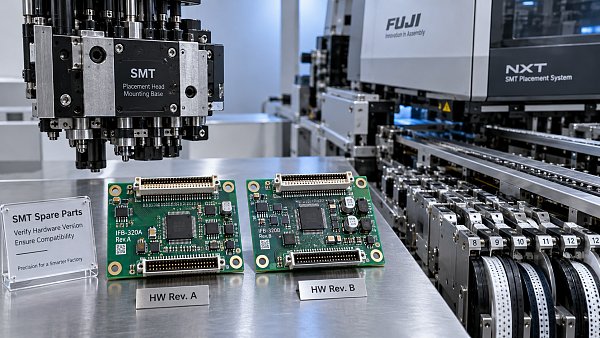
Many downtime events are prolonged not by the fault itself, but by uncertainty after the fault is found. The team may know that a feeder mechanism, drive component, sensor, nozzle, belt, camera-related assembly, or pneumatic part needs replacement, yet still need to confirm the exact revision, compatibility, and source. A substitute part that looks similar may introduce another problem: poor fit, inconsistent performance, unavailable documentation, or a mismatch with the machine configuration.
For this reason, spare-part management should be connected to maintenance planning rather than treated as a separate purchasing task. Critical spares are not necessarily the most expensive items. They are the items whose failure would stop a constraint machine, affect more than one product family, or require a long verification process before installation. The right stock profile depends on equipment configuration and production priorities; it should not be copied blindly from another site.
Original machine spare parts can reduce the risk associated with fitment and traceability, provided the part number and machine applicability are checked carefully. This matters when servicing equipment that has been modified, upgraded, moved between plants, or maintained over many years. Maintenance teams should retain serial-number information, service history, installed options, and relevant part revisions so that urgent procurement does not become a process of elimination.
Maintenance should follow the flow of the whole line
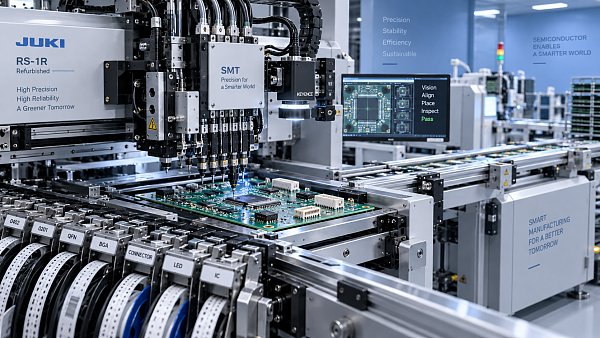
A stopped placement machine is visible. A poorly maintained interface between machines is often less visible until it disrupts the entire line. Board loaders, conveyors, buffers, printers, SPI systems, placement machines, reflow ovens, AOI equipment, unloaders, and THT stations each have their own maintenance needs, but they also depend on stable handoffs.
For example, an intermittent board transfer issue may look like a placement fault because the downstream machine is waiting for material. A printing inconsistency may generate placement-related rejects that lead teams to investigate the wrong asset first. In mixed SMT/THT operations, manual handling, fixture condition, selective soldering steps, and inspection queues can introduce delays that are mistaken for equipment availability problems.
That is why an effective service scope starts with the production flow. Which machine constrains output? Which faults stop the line immediately? Which quality issue creates a hold that is operationally equivalent to downtime? Where are operators routinely intervening? These questions help prevent a narrow maintenance program from optimizing a single machine while leaving the actual bottleneck untouched.
SMT MALLS focuses on SMT/THT assembly equipment, original machine spare parts, and complete PCB assembly line solutions. In a maintenance discussion, that broader perspective is useful because the practical answer may involve more than a repair visit. It may require confirming a spare-part list, checking a feeder or conveyor interface, reviewing an aging machine’s supportability, or planning maintenance around the interaction of several process stations.
What decision-makers should ask before approving a service plan
The question is not whether preventive maintenance is worthwhile in principle. It is whether the planned work addresses the most credible causes of lost production. Before approving a program, it is reasonable to ask how service priorities were selected and what evidence supports them.
- Which equipment faults have caused the most production interruption, quality holds, or repeat alarms?
- What maintenance tasks are required by the machine manufacturer, and which tasks are added because of local operating conditions?
- Which assemblies are inspected, cleaned, calibrated, adjusted, or replaced during the planned service window?
- What parts must be available before service begins, and how will part compatibility be verified?
- How will the line be checked after maintenance: machine function, placement quality, board transfer, thermal process, or product-specific validation?
The final question is particularly important. A maintenance activity is not complete when the machine powers on. It is complete when the equipment can return to controlled production without creating a hidden quality risk. The depth of post-service verification should reflect the equipment involved and the manufacturer’s internal process requirements.
The most useful time to act is before a small fault becomes normal
Unplanned downtime is rarely prevented by one dramatic intervention. It is avoided through routine attention to changes that people may otherwise learn to tolerate: the feeder that needs a second attempt, the machine that needs an extra reset, the conveyor that occasionally hesitates, the alarm that appears only on one shift, or the spare part that no one has checked for availability because it has not failed yet.
SMT Equipment Maintenance Services are most effective when they turn those weak signals into planned actions. For semiconductor component manufacturers, the right approach is usually a combination of condition review, disciplined preventive tasks, accurate fault records, original-part verification, and line-level thinking. Before the next peak production period, review the assets that constrain output, the alarms that recur, and the parts that would be difficult to replace. That review often reveals where a planned maintenance window can prevent a much more disruptive stop later.


GET A FREE QUOTE
Simply fill in the information to get a free quote! Our professional team customizes photovoltaic solutions for you, provides accurate quotes, and rejects hidden consumption!
